Showing posts with label Submachine gun. Show all posts

Friday, November 5, 2010

AEK-919 K "Kashtan" submachine gun (Russia)

AEK-919 K "Kashtan" submachine gun

AEK-919 submachine gun was developed at the Kovrov Mechanical Plant in the mid-1990s for Russian Army and special law-enforcement forces. Initial design was based on Austrian Steyr MPi-69 submachine gun, and was not withouth a certain flaws. After initial testings design was improved - overall lenght was decreased, cross-bolt safety switch was replaced by the rotating fire selector/safety swithch; ergonomics also was improved. Resulting design was named AEK-919K "Kashtan" and probably is used in small numbers by different special forces of the Russian Army and Law Enforcement units.

AEK-919K is a simple blowback operated, selective fire submachine gun. It featured a "sleeved" bolt which, in forward position, encloses the rear part of the barrel. AEK-919K is fired from the open bolt, and fed from the two-column magazines that hold 20 or 30 rounds. Receiver is made from the stamped steel, pistol grip with triggerguard and a heatshield are made from the plastic. Cocking handle is located at the left side of the receiver and does not move when gun is fired. AEK-919K featured an "L"-shaped open rear sights marked for 50 and 100 meters distance, it also can be equipped with laser aiming device and "red dot" sight. Barrel of the AEK-919K featured polygonal rifling and threaded muzzle, so a silencer can be quickly installed if required. Retractable stock is made from the steel, with rubberised buttplate.

AEK-919K is a compact and handy firerarm, and the only drawback i found when holding that gun at one of the exhibitions is in the placement of the safety/selector switch. When gun is in the "safe" mode, it is almost impossible to switch the gun into "fire" mode withouth the weak (non-firing) hand or withouth rotating the gun in the palm. In all other respects AEK-919K is reported to be accurate, reliable and comfortable to fire, even from off-hands. A currently advertised along with AEK-919K "red dot" sight is a little bit cumbersome but it allows for much faster target aquisition; any other, more compaqct "red dot" sight also can be installed withouth getting into much (if any) trouble.

AEK-919 K "Kashtan" submachine gun (Russia)

AEK-919 K "Kashtan" submachine gun

AEK-919 submachine gun was developed at the Kovrov Mechanical Plant in the mid-1990s for Russian Army and special law-enforcement forces. Initial design was based on Austrian Steyr MPi-69 submachine gun, and was not withouth a certain flaws. After initial testings design was improved - overall lenght was decreased, cross-bolt safety switch was replaced by the rotating fire selector/safety swithch; ergonomics also was improved. Resulting design was named AEK-919K "Kashtan" and probably is used in small numbers by different special forces of the Russian Army and Law Enforcement units.

AEK-919K is a simple blowback operated, selective fire submachine gun. It featured a "sleeved" bolt which, in forward position, encloses the rear part of the barrel. AEK-919K is fired from the open bolt, and fed from the two-column magazines that hold 20 or 30 rounds. Receiver is made from the stamped steel, pistol grip with triggerguard and a heatshield are made from the plastic. Cocking handle is located at the left side of the receiver and does not move when gun is fired. AEK-919K featured an "L"-shaped open rear sights marked for 50 and 100 meters distance, it also can be equipped with laser aiming device and "red dot" sight. Barrel of the AEK-919K featured polygonal rifling and threaded muzzle, so a silencer can be quickly installed if required. Retractable stock is made from the steel, with rubberised buttplate.

AEK-919K is a compact and handy firerarm, and the only drawback i found when holding that gun at one of the exhibitions is in the placement of the safety/selector switch. When gun is in the "safe" mode, it is almost impossible to switch the gun into "fire" mode withouth the weak (non-firing) hand or withouth rotating the gun in the palm. In all other respects AEK-919K is reported to be accurate, reliable and comfortable to fire, even from off-hands. A currently advertised along with AEK-919K "red dot" sight is a little bit cumbersome but it allows for much faster target aquisition; any other, more compaqct "red dot" sight also can be installed withouth getting into much (if any) trouble.

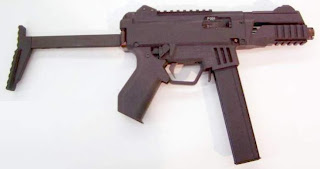
Jati-Matic submachine gun / GG-95 PDW (Finland)

Jati-Matic submachine gun / GG-95 PDW

Jati-Matic submachine gun was designed by Jali Timari and manufactured at Tampeeren Asepaja Oy, Finland, in 1980 - 1987. In 1995 the Jati-Matic briefly appeared again, under the name of GG-95 PDW from finnish company Oy Golden Gun Ltd.

Jati-Matic is a blowback operated, select-fire submachine gun. The bolt recoils up an inclined plane at angle to the barrel, giving an element of braking to the bolt, and also resisting the upward movement of the barrel during the fire. The pistol grip is located higher than on many other SMGs, giving the better control over the recoil. Jati-Matic has no buttstock and has folding forward grip, which also acts as a cocking handle when opened. When folded, front grip also provides an element of mechanical safety, blocking the bolt. The receiver is made from pressed steel with hinged top cover. The selection of the fire mode (single or full auto) can be done with different trigger pulls - short pull produced single shots, long pull - full auto fire.

Jati-Matic submachine gun / GG-95 PDW (Finland)

Jati-Matic submachine gun / GG-95 PDW

Jati-Matic submachine gun was designed by Jali Timari and manufactured at Tampeeren Asepaja Oy, Finland, in 1980 - 1987. In 1995 the Jati-Matic briefly appeared again, under the name of GG-95 PDW from finnish company Oy Golden Gun Ltd.

Jati-Matic is a blowback operated, select-fire submachine gun. The bolt recoils up an inclined plane at angle to the barrel, giving an element of braking to the bolt, and also resisting the upward movement of the barrel during the fire. The pistol grip is located higher than on many other SMGs, giving the better control over the recoil. Jati-Matic has no buttstock and has folding forward grip, which also acts as a cocking handle when opened. When folded, front grip also provides an element of mechanical safety, blocking the bolt. The receiver is made from pressed steel with hinged top cover. The selection of the fire mode (single or full auto) can be done with different trigger pulls - short pull produced single shots, long pull - full auto fire.

Port-Said submachine gun

Port-Said submachine gun

Port-Said submachine gun

In early 1950s Egyptean government acquired necessary machinery and manufacturing documentation from Sweden to produce a local copy of the Swedish Carl Gustaf M/45 submachine gun. Originally known as “Port-Said”, the Swedish design was later simplified in Egyptian production by discarding barrel jacket and simplifying the sights and shoulder stock. This less expensive and somewhat more roughly finished version was produced as “Akaba” or “Kara” submachine gun.

Port-Said submachine gun is a simple blowback operated, full automatic only firearm that fires from open bolt. The receiver is made from steel tube, the separate barrel jacket is also made from perforated steel tube. Despite the fact that Egyptean submachine guns used only one type of magazine, the 36-round double stack, double feed box magazines designed for Swedish M/45 submachine guns, they retained removable magazine housings of earliest Swedish submachine guns, which were intended to allow use of various types of magazines. The manual safety is made in the form of an L-shaped cut made at the rear of the cocking handle slot; it is used to engage cocking handle when bolt is in retracted position. The sights consist of front blade and flip-type rear sight, marked for 100 and 200 meters. Shoulder stock is made from thin steel tubing and folds forward and to the right.

Port-Said submachine gun

Port-Said submachine gun

Port-Said submachine gun

In early 1950s Egyptean government acquired necessary machinery and manufacturing documentation from Sweden to produce a local copy of the Swedish Carl Gustaf M/45 submachine gun. Originally known as “Port-Said”, the Swedish design was later simplified in Egyptian production by discarding barrel jacket and simplifying the sights and shoulder stock. This less expensive and somewhat more roughly finished version was produced as “Akaba” or “Kara” submachine gun.

Port-Said submachine gun is a simple blowback operated, full automatic only firearm that fires from open bolt. The receiver is made from steel tube, the separate barrel jacket is also made from perforated steel tube. Despite the fact that Egyptean submachine guns used only one type of magazine, the 36-round double stack, double feed box magazines designed for Swedish M/45 submachine guns, they retained removable magazine housings of earliest Swedish submachine guns, which were intended to allow use of various types of magazines. The manual safety is made in the form of an L-shaped cut made at the rear of the cocking handle slot; it is used to engage cocking handle when bolt is in retracted position. The sights consist of front blade and flip-type rear sight, marked for 100 and 200 meters. Shoulder stock is made from thin steel tubing and folds forward and to the right.

Akaba submachine gun

Akaba submachine gun

Akaba submachine gun

Akaba submachine gun

Saturday, September 11, 2010

Ingram Model 6 (M6) submachine gun

http://powerful-gun.blogspot.com/
Ingram M6 (model 6) submachine gun in "Military" configuration

http://powerful-gun.blogspot.com/
Ingram M7 (model 7) submachine gun in "Police" configuration

Caliber 9x19mm, .38 Super and .45 ACP
Weight ~3,3 kg empty
Length 762 mm
Barrel length 228 mm
Rate of fire 600 rounds per minute
Magazine capacity 30 rounds
Effective range 100 meters

Gordon Ingram designed his first prototype submachine gun during late 1940s; soon after his first prototype he produced next design, known as Model 6. This gun was manufactured by American company Police Ordnance Co between 1949 and 1952; about 15 to 20 thousands of Model 6 submachine guns were made and sold to Cuban Navy, Peruvian Army and some US Police departments. In about 1952 Ingram also designed an improved version of the Model 6, known as Model 7. This weapon was externally similar to Model 6 but fired from closed bolt, and had a separate fire mode selector. Very few Model 7 submachine guns were produced.
Ingram Model 6 submachine guns were produced in two basic configurations, "Military" and "Police". The "Military" version had plain wooden forearm, plain barrel and protected front sight. It also was capable to mount a proprietary spike-shaped bayonet, which was stored inside the forearm in reversed position when not required. "Police" version of Model 6 featured a front foregrip similar to that of Thompson submachine gun, and a partially finned barrel.

Ingram Model 6 submachine gun is blowback operated, selective fired weapon that fired from open bolt. The only safety provided was the locking notch in the cocking handle slot, which was used to lock the bolt by its handle in cocked (retracted) position. Selection of mode of fire was made by the pull of the trigger - short pull produced single shots, and long pull produced full automatic fire.

Ingram Model 6 (M6) submachine gun

http://powerful-gun.blogspot.com/
Ingram M6 (model 6) submachine gun in "Military" configuration

http://powerful-gun.blogspot.com/
Ingram M7 (model 7) submachine gun in "Police" configuration

Caliber 9x19mm, .38 Super and .45 ACP
Weight ~3,3 kg empty
Length 762 mm
Barrel length 228 mm
Rate of fire 600 rounds per minute
Magazine capacity 30 rounds
Effective range 100 meters

Gordon Ingram designed his first prototype submachine gun during late 1940s; soon after his first prototype he produced next design, known as Model 6. This gun was manufactured by American company Police Ordnance Co between 1949 and 1952; about 15 to 20 thousands of Model 6 submachine guns were made and sold to Cuban Navy, Peruvian Army and some US Police departments. In about 1952 Ingram also designed an improved version of the Model 6, known as Model 7. This weapon was externally similar to Model 6 but fired from closed bolt, and had a separate fire mode selector. Very few Model 7 submachine guns were produced.
Ingram Model 6 submachine guns were produced in two basic configurations, "Military" and "Police". The "Military" version had plain wooden forearm, plain barrel and protected front sight. It also was capable to mount a proprietary spike-shaped bayonet, which was stored inside the forearm in reversed position when not required. "Police" version of Model 6 featured a front foregrip similar to that of Thompson submachine gun, and a partially finned barrel.

Ingram Model 6 submachine gun is blowback operated, selective fired weapon that fired from open bolt. The only safety provided was the locking notch in the cocking handle slot, which was used to lock the bolt by its handle in cocked (retracted) position. Selection of mode of fire was made by the pull of the trigger - short pull produced single shots, and long pull produced full automatic fire.

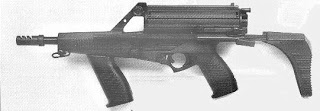
Calico M960 submachine gun

http://powerful-gun.blogspot.com/
Caliber: 9x19mm Luger/Para
Weight: 2.17 kg empty
Length (stock closed/open): 647 / 835 mm
Barrel length: 330 mm
Rate of fire: 750 rounds per minute
Magazine capacity: 50 or 100 rounds

Calico M960 submachine gun

http://powerful-gun.blogspot.com/
Caliber: 9x19mm Luger/Para
Weight: 2.17 kg empty
Length (stock closed/open): 647 / 835 mm
Barrel length: 330 mm
Rate of fire: 750 rounds per minute
Magazine capacity: 50 or 100 rounds

Star SI-35 RU-35 TN-35 submachine gun

http://powerful-gun.blogspot.com/Star RU-35 submachine gun, left side

http://powerful-gun.blogspot.com/Star RU-35 submachine gun, right side

http://powerful-gun.blogspot.com/Star RU-35 submachine gun, close-up view on the controls (fire mode selector, left, and rate of fire selector, right)

Caliber 9x23 Largo
Weight 3.74 kg
Length (stock closed/open) 900 mm
Barrel length 269 mm
Rate of fire 300 or 700 rounds per minute
Magazine capacity 10, 30 or 40 rounds

This submachine gun was developed by mid-1930s by famous Spanish arms-making company Bonifacio Echeverria SA, which operated under the trademark "Star". There were three slightly different model in the 1935 Star line of submachine guns: the RU-35, which had slow rate of fire of about 300 rounds per minute, the TN-35, which had fast rate of fire of about 700 rounds per minute, and the SI-35, which has dual (selectable) rate of fire. Otherwise all three weapons were similar, sharing same layout, same complicated delayed blowback action, and same overly complicated controls setup, consisting of two multi-position levers on the left side of the receiver. These submachine guns were manufactured in Spain and used by Guarda Civil. During the WW2, a version of this submachine gun was tested in USA and UK under the name "Atlantic", but was rejected on the grounds of the complexity and excessive costs of manufacture.

Star RU-35 / SI-35 submachine gun utilizes delayed (retarded) blowback operation, using two-part bolt with special locking piece, which temporary locks the bolt head to the receiver upon the early stages of recoil. Gun fires from open bolt, in full and semi-automatic modes. The SI-35 version has additional rate of fire reducer which is controlled by the rear switch on the left side of the receiver (it also doubles as a safety). Forward switch controls modes of fire (semi-automatic or full automatic). Feed is from detachable box magazines, which were supplied in various capacities. Rear sight was adjustable for range from 50 and up to very optimistic 1000 meters range. Gun was fitted with wooden stock, barrel was enclosed into slotted jacket, which also carried muzzle brake - compensator and a bayonet lug.

Star SI-35 RU-35 TN-35 submachine gun

http://powerful-gun.blogspot.com/Star RU-35 submachine gun, left side

http://powerful-gun.blogspot.com/Star RU-35 submachine gun, right side

http://powerful-gun.blogspot.com/Star RU-35 submachine gun, close-up view on the controls (fire mode selector, left, and rate of fire selector, right)

Caliber 9x23 Largo
Weight 3.74 kg
Length (stock closed/open) 900 mm
Barrel length 269 mm
Rate of fire 300 or 700 rounds per minute
Magazine capacity 10, 30 or 40 rounds

This submachine gun was developed by mid-1930s by famous Spanish arms-making company Bonifacio Echeverria SA, which operated under the trademark "Star". There were three slightly different model in the 1935 Star line of submachine guns: the RU-35, which had slow rate of fire of about 300 rounds per minute, the TN-35, which had fast rate of fire of about 700 rounds per minute, and the SI-35, which has dual (selectable) rate of fire. Otherwise all three weapons were similar, sharing same layout, same complicated delayed blowback action, and same overly complicated controls setup, consisting of two multi-position levers on the left side of the receiver. These submachine guns were manufactured in Spain and used by Guarda Civil. During the WW2, a version of this submachine gun was tested in USA and UK under the name "Atlantic", but was rejected on the grounds of the complexity and excessive costs of manufacture.

Star RU-35 / SI-35 submachine gun utilizes delayed (retarded) blowback operation, using two-part bolt with special locking piece, which temporary locks the bolt head to the receiver upon the early stages of recoil. Gun fires from open bolt, in full and semi-automatic modes. The SI-35 version has additional rate of fire reducer which is controlled by the rear switch on the left side of the receiver (it also doubles as a safety). Forward switch controls modes of fire (semi-automatic or full automatic). Feed is from detachable box magazines, which were supplied in various capacities. Rear sight was adjustable for range from 50 and up to very optimistic 1000 meters range. Gun was fitted with wooden stock, barrel was enclosed into slotted jacket, which also carried muzzle brake - compensator and a bayonet lug.

Star Z-45 submachine gun

http://powerful-gun.blogspot.com/
Star Z-45 submachine gun

Caliber 9x23 Largo
Weight 3.87 kg
Length (stock closed/open) 580 / 841 mm
Barrel length 192 mm
Rate of fire 450 rounds per minute
Magazine capacity 10 or 30 rounds

The Star Z-45 submachine gun was developed in Spain by famous arms-making company Bonifacio Echeverria SA toward the end of the World War 2. It can be considered as an improved and refined version of the famous German MP40 submachine gun. The Star Z-45 submachine gun turned to be a robust and reliable weapon, and it successfully served with Spanish army and police for several decades after WW2. It was also exported to some South and Central American and Asian countries.

Star Z-45 submachine gun is based on simple blowback action, firing from open bolt. The bolt / return spring / telescoped guide setup is based on MP40. Z-45 also has similar safety arrangements ( laterally sliding bolt handle that locks the bolt when pushed inwards, plus L-shaped cut in the bolt handle slot to lock the bolt in rearward position). The Star Z-45 submachine gun can fire in single shots or full automatic, with selection being made through the pull of the trigger (short pull produces single shots, long pull - full automatic fire). Gun is fitted with wooden pistol grip and forend, and with bottom-folding metallic buttstock (all patterned after the MP40). The barrel is enclosed into slotted jacket, with muzzle brake - compensator at the front. The flip-up backsight is of L-shaped profile, with settings for 50 and 100 meters.

Star Z-45 submachine gun

http://powerful-gun.blogspot.com/
Star Z-45 submachine gun

Caliber 9x23 Largo
Weight 3.87 kg
Length (stock closed/open) 580 / 841 mm
Barrel length 192 mm
Rate of fire 450 rounds per minute
Magazine capacity 10 or 30 rounds

The Star Z-45 submachine gun was developed in Spain by famous arms-making company Bonifacio Echeverria SA toward the end of the World War 2. It can be considered as an improved and refined version of the famous German MP40 submachine gun. The Star Z-45 submachine gun turned to be a robust and reliable weapon, and it successfully served with Spanish army and police for several decades after WW2. It was also exported to some South and Central American and Asian countries.

Star Z-45 submachine gun is based on simple blowback action, firing from open bolt. The bolt / return spring / telescoped guide setup is based on MP40. Z-45 also has similar safety arrangements ( laterally sliding bolt handle that locks the bolt when pushed inwards, plus L-shaped cut in the bolt handle slot to lock the bolt in rearward position). The Star Z-45 submachine gun can fire in single shots or full automatic, with selection being made through the pull of the trigger (short pull produces single shots, long pull - full automatic fire). Gun is fitted with wooden pistol grip and forend, and with bottom-folding metallic buttstock (all patterned after the MP40). The barrel is enclosed into slotted jacket, with muzzle brake - compensator at the front. The flip-up backsight is of L-shaped profile, with settings for 50 and 100 meters.

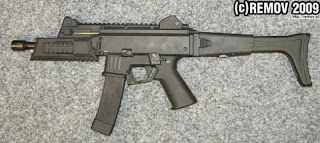
SKORPION / SCORPION EVO III submachine gun

http://powerful-gun.blogspot.com/SKORPION EVO III submachine gun

http://powerful-gun.blogspot.com/SKORPION EVO III submachine gun

http://powerful-gun.blogspot.com/SKORPION EVO III submachine gun

Caliber 9x19mm Luger / Parabellum
Weight 2.1 kg empty
Length (stock closed/open) 400 / 650 mm
Barrel length 196 mm
Rate of fire 1100 rounds per minute
Magazine capacity 20 or 30 rounds

SKORPION EVO III submachine gun is a most recent product of the famous Czech small arms manufacturer ÄŒeska Zbrojevka Uherski Brod (CZ-UB). This weapon began its life in Slovakia in around 2002, as the Laugo submachine gun / personal defense weapon. Once the design became mature, it was sold to CZ-UB, which brought it to public attention in 2009 as SKORPION EVO III submachine gun. It seems that this weapon is targeted for police market, but it also can found some use by certain military units. An export version of the SKORPION EVO III submachine gun is also proposed, chambered for .40SW ammunition which is very popular as a police round in USA and certain South American countries.

SKORPION EVO III submachine gun is a simple blowback operated, selective fired weapon that fires from closed bolt. It has a separate hammer unit, with ambidextrous safety / fire mode selector, that offers single shots, 3-round bursts and full automatic fire modes. The charging handle is located on the left side of the gun, above the forend. The receiver, pistol grip / trigger unit and the forend all are made from polymer. The side-folding shoulder stock is also made from polymer, and can be adjusted for length of pull due to telescopic design. Iron sights are installed on removable bases, using integral Picatinny type rail on the top of receiver. Additional sighting equipment can be added using this same rail; three more accessory rails are installed at the sides and bottom of the forend. Feed is from detachable box magazines, made of semi-translucent plastic, that hold 20 or 30 rounds of ammunition.

SKORPION / SCORPION EVO III submachine gun

http://powerful-gun.blogspot.com/SKORPION EVO III submachine gun

http://powerful-gun.blogspot.com/SKORPION EVO III submachine gun

http://powerful-gun.blogspot.com/SKORPION EVO III submachine gun

Caliber 9x19mm Luger / Parabellum
Weight 2.1 kg empty
Length (stock closed/open) 400 / 650 mm
Barrel length 196 mm
Rate of fire 1100 rounds per minute
Magazine capacity 20 or 30 rounds

SKORPION EVO III submachine gun is a most recent product of the famous Czech small arms manufacturer ÄŒeska Zbrojevka Uherski Brod (CZ-UB). This weapon began its life in Slovakia in around 2002, as the Laugo submachine gun / personal defense weapon. Once the design became mature, it was sold to CZ-UB, which brought it to public attention in 2009 as SKORPION EVO III submachine gun. It seems that this weapon is targeted for police market, but it also can found some use by certain military units. An export version of the SKORPION EVO III submachine gun is also proposed, chambered for .40SW ammunition which is very popular as a police round in USA and certain South American countries.

SKORPION EVO III submachine gun is a simple blowback operated, selective fired weapon that fires from closed bolt. It has a separate hammer unit, with ambidextrous safety / fire mode selector, that offers single shots, 3-round bursts and full automatic fire modes. The charging handle is located on the left side of the gun, above the forend. The receiver, pistol grip / trigger unit and the forend all are made from polymer. The side-folding shoulder stock is also made from polymer, and can be adjusted for length of pull due to telescopic design. Iron sights are installed on removable bases, using integral Picatinny type rail on the top of receiver. Additional sighting equipment can be added using this same rail; three more accessory rails are installed at the sides and bottom of the forend. Feed is from detachable box magazines, made of semi-translucent plastic, that hold 20 or 30 rounds of ammunition.

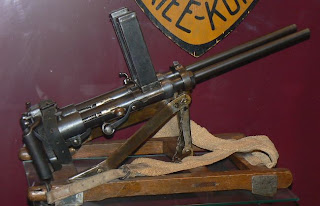
Villar-Perosa OVP submachine gun

http://powerful-gun.blogspot.com/Villar-Perosa M1915 twin-barrel submachine gun on the one-man portable "tray" mount, used by mountain troops. Photo from Austrian army museum, Vienna

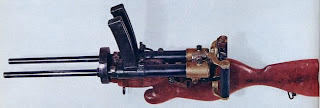
http://powerful-gun.blogspot.com/Villar-Perosa M1915 twin-barrel submachine gun, fitted with wooden stock for off-hand use
http://powerful-gun.blogspot.com/
Villar-Perosa OVP M1918 submachine gun (automatic carbine). Single-barreled hand-held submachine gun produced from 1/2 of the original Villar-Perosa M1915 weapon


Villar-Perosa M1915Villar-Perosa M1918
Caliber 9x19mm Glisenti 9x19mm Glisenti
Weight, empty 6.5 kg (less mount) 3.6 kg
Length (stock closed/open) mm 902 mm
Barrel length 279 mm 279 mm
Rate of fire 2 x 1200 - 1500 rounds per minute 900 rounds per minute
Magazine capacity 2 x 25 rounds 25 rounds

The Villar Perosa submachine gun is one of the most unusual weapons that emerged during the WW1. The name of the weapon comes from the name of the company that manufactured these guns, the Officine Villar Perosa (OVP in short). This gun was originally designed in 1914 by famous Italian small arms designer Bethel Abiel Revelli as an aircraft weapon. In this role it found no success, as it was designed to fire low-powered 9mm Glisenti ammunition, which was even weaker than dimensionally similar 9x19 Luger ammunition. In 1915 the Villar-Perosa was converted for ground applications, with introduction of variety of mountings, including light tripods or carrying trays (which were carried on shoulder straps or put on the ground for more stable position and less exposure to enemy fire). Later on, a wooden rifle-type stock was designed for Villar-Perosa, so it could be fired more or less comfortable from the shoulder, thus creating the first practical submachine gun in the world. After the war, some of the original Villar-Perosa weapons (which were actually assemblies of two similar guns) were disassembled into halves, and put into rifle type stocks, with addition of the rifle-type triggers. Such conversions were known as Villar Perosa OVP M1918 (when done by Villar Perosa). A slightly improved version of the same design was also produced by Beretta company, and it was known as Beretta M1918.

The Villar Perosa M1915 weapon was assembled from two guns of exactly same design and appearance, which were held together by the plate at the front of the receiver and by the twin spade grips assembly at the rear. Each gun has its own trigger, operated by a separate thumb button between spade grips. The guns themselves used delayed blowback action, in which the delay of the initial opening of the bolt was achieved by rotation of the bolt through the bolt handle that slid against the inclined part of the cocking handle slot. The bolt rotation, combined with separate firing pin, provided safety measure against premature ignition of the cartridge, as the firing pin was able to go forward and strike the primer only when bolt was in battery and completely rotated. Guns fired from open bolt, in full automatic mode only. Due to the lightweight bolt and powerful springs, the rate of fire was excessively high for the ground applications, being between 1200 and 1500 rounds per one gun (rising up to 3000 rounds per minute when both guns were fired at once). The feed was from detachable box magazines, holding just 25 rounds each, so one magazine was forth just one second of the continuous fire. Magazines were inserted into the each gun vertically from the top, ejection was to the bottom. Sights were located between the guns, with rear sight being built into the spade grip assembly and the front sight into the front plate that held both guns together.

The OVP M1918 submachine gun was made from one gun from the original M1914 twin weapon, with added shoulder stock and a new dual trigger setup, which allowed for single shots (rear trigger) and full automatic fire (front trigger). The cocking of the bolt was achieved by pulling back the knurled sliding sleeve, located around the receiver. Feed arrangement was similar to the original twin weapon, with top-mounted box magazine. The rate of fire was somewhat lower, making this gun somewhat more controllable and more useful in ground combat. A new set of sights was installed, with line of sight necessarily moved to the left to clear the magazine.

Villar-Perosa OVP submachine gun

http://powerful-gun.blogspot.com/Villar-Perosa M1915 twin-barrel submachine gun on the one-man portable "tray" mount, used by mountain troops. Photo from Austrian army museum, Vienna

http://powerful-gun.blogspot.com/Villar-Perosa M1915 twin-barrel submachine gun, fitted with wooden stock for off-hand use
http://powerful-gun.blogspot.com/
Villar-Perosa OVP M1918 submachine gun (automatic carbine). Single-barreled hand-held submachine gun produced from 1/2 of the original Villar-Perosa M1915 weapon


Villar-Perosa M1915Villar-Perosa M1918
Caliber 9x19mm Glisenti 9x19mm Glisenti
Weight, empty 6.5 kg (less mount) 3.6 kg
Length (stock closed/open) mm 902 mm
Barrel length 279 mm 279 mm
Rate of fire 2 x 1200 - 1500 rounds per minute 900 rounds per minute
Magazine capacity 2 x 25 rounds 25 rounds

The Villar Perosa submachine gun is one of the most unusual weapons that emerged during the WW1. The name of the weapon comes from the name of the company that manufactured these guns, the Officine Villar Perosa (OVP in short). This gun was originally designed in 1914 by famous Italian small arms designer Bethel Abiel Revelli as an aircraft weapon. In this role it found no success, as it was designed to fire low-powered 9mm Glisenti ammunition, which was even weaker than dimensionally similar 9x19 Luger ammunition. In 1915 the Villar-Perosa was converted for ground applications, with introduction of variety of mountings, including light tripods or carrying trays (which were carried on shoulder straps or put on the ground for more stable position and less exposure to enemy fire). Later on, a wooden rifle-type stock was designed for Villar-Perosa, so it could be fired more or less comfortable from the shoulder, thus creating the first practical submachine gun in the world. After the war, some of the original Villar-Perosa weapons (which were actually assemblies of two similar guns) were disassembled into halves, and put into rifle type stocks, with addition of the rifle-type triggers. Such conversions were known as Villar Perosa OVP M1918 (when done by Villar Perosa). A slightly improved version of the same design was also produced by Beretta company, and it was known as Beretta M1918.

The Villar Perosa M1915 weapon was assembled from two guns of exactly same design and appearance, which were held together by the plate at the front of the receiver and by the twin spade grips assembly at the rear. Each gun has its own trigger, operated by a separate thumb button between spade grips. The guns themselves used delayed blowback action, in which the delay of the initial opening of the bolt was achieved by rotation of the bolt through the bolt handle that slid against the inclined part of the cocking handle slot. The bolt rotation, combined with separate firing pin, provided safety measure against premature ignition of the cartridge, as the firing pin was able to go forward and strike the primer only when bolt was in battery and completely rotated. Guns fired from open bolt, in full automatic mode only. Due to the lightweight bolt and powerful springs, the rate of fire was excessively high for the ground applications, being between 1200 and 1500 rounds per one gun (rising up to 3000 rounds per minute when both guns were fired at once). The feed was from detachable box magazines, holding just 25 rounds each, so one magazine was forth just one second of the continuous fire. Magazines were inserted into the each gun vertically from the top, ejection was to the bottom. Sights were located between the guns, with rear sight being built into the spade grip assembly and the front sight into the front plate that held both guns together.

The OVP M1918 submachine gun was made from one gun from the original M1914 twin weapon, with added shoulder stock and a new dual trigger setup, which allowed for single shots (rear trigger) and full automatic fire (front trigger). The cocking of the bolt was achieved by pulling back the knurled sliding sleeve, located around the receiver. Feed arrangement was similar to the original twin weapon, with top-mounted box magazine. The rate of fire was somewhat lower, making this gun somewhat more controllable and more useful in ground combat. A new set of sights was installed, with line of sight necessarily moved to the left to clear the magazine.

Blog Archive